


Hans-Georg Baunach
Management
Air/water heat pump: improved hydraulics result in a coefficient of performance of 8.0

“Carnot won’t allow that,” was a comment heard more than once at the recent ISH trade fair during discussions about renovating old buildings with air/water heat pumps. With a maximum COP of 3.5, that’s the end of the line. The founder of thermodynamics – Nicolas Léonard Sadi Carnot – must have regularly turned in his grave he heard that. Because he allows everything. Nowhere in his cycle does the energy source appear – only temperatures. Matthias Westermann, a planner and energy consultant, presented an installation with an impressive efficiency rating of 8: 8 kWh of heat from 1 kWh of electricity plus a few thousand cubic metres of air. In short: the better the heat pump is integrated into the heating circuit, the higher the coefficient of performance.
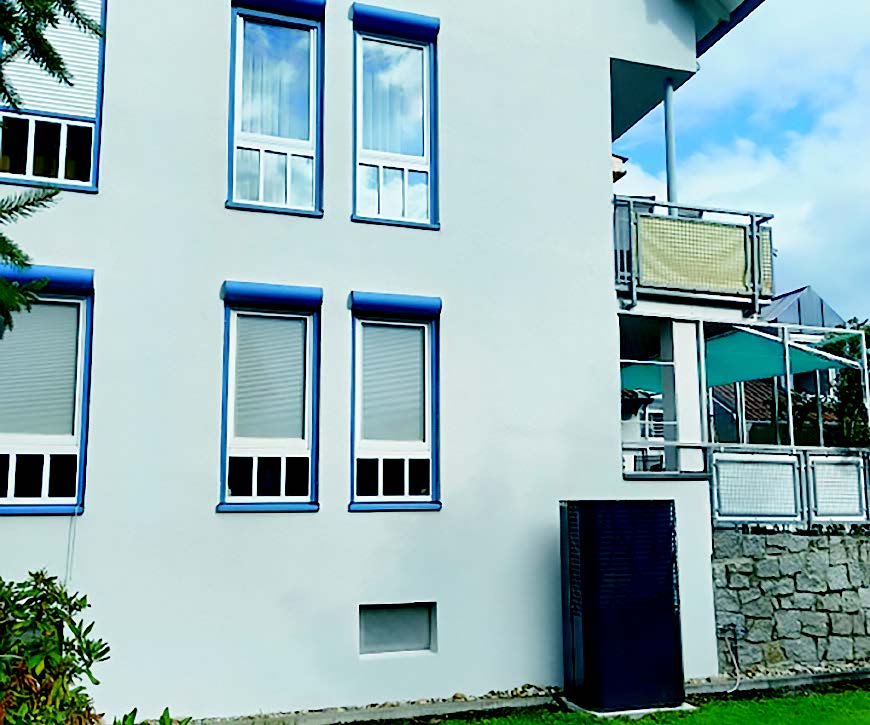
First of all: the following article does not slavishly adhere to the standard designations. The “quality factor” is used here as a synonym for the annual performance factor (APF), for seasonal COP (SCOP), for efficiency and for all other descriptions that directly or indirectly reflect the ratio of heat output to electricity input . As mentioned above, the majority of experts do not consider a heat pump with outside air as an energy source to be suitable for renovating old buildings, citing Carnot’s principle. Almost incredulous, or at least highly astonished, visitors to a stand at the ISH 2025 trade fair in Frankfurt heard about the renovation of a four-family house in Bischweier not far from Karlsruhe, in which the JAZ is said to be approaching 8.0 – not a one-off 8.0, but rather the result after several months of operation and measurements with the electricity meter on the one hand and the heat meter on the other. JAZ 2, 5, 8, 10, 20 or more – four factors, in addition to the current tariff, determine the heating costs: the weather, the flow temperature, optimised heat pump components and an intelligent connection of the air/water heat pump to the heating circuit. Planner and energy consultant Matthias Westermann had to to visit a complaining customer because it was too warm and the room temperature could not be lowered any further. He reported that the fault was found relatively quickly: he only had to lower the heating curve. The heating engineer responsible for the installation had set the outside temperature too low, or rather, he had set a minimum of -4 °C in February as the average standard value for the Karlsruhe area. In fact, however, the thermometer did not drop that low. On the contrary, it climbed to 12-14 °C on some days, as recorded by the German Weather Service (DWD). In fact, however, the thermometer did not drop that low. On the contrary, on some days it climbed to 12-14 °C, as recorded by the German Weather Service (DWD). In Bischweier, the location of the heat pump conversion from natural gas to heat pump electricity, the sensors measured an average temperature of 5 °C for the past heating season, making it one of the warmest winters since records began. If climate change continues, the DWD predicts winter high temperatures of around 17-18 °C in 2040 and an average (!) of 8 °C.
Carnot knows no bounds
Air/water heat pumps naturally benefit significantly from such conditions. Their seasonal COP is already approaching that of geothermal systems, which in late winter, around February and March, lose their thermal potential due to heat extraction starting in October – and consequently their SCOP drops. The long-term average for the ground temperature in the Karlsruhe region in March is around 4 °C. This means that, in general, the design of heat pumps for the past heating season is based on a ground temperature of 5 °C, making this one of the warmest winters since records began. If climate change continues, the DWD is predicting winter high temperatures of around 17-18 °C in 2040 and an average value (!) of 8 °C. potential – and consequently their SCOP falls. The long-term average soil temperature in the Karlsruhe region in March is around 4 °C. This means that, in general, when designing and installing systems, it is important to find out what temperatures can be expected at the property. The coefficient of performance of 3.5 for the outside air models is accurate in this respect, if one assumes standardised winter temperatures of -10 °C (263 K) and room temperatures of 22 °C (295 K) for the whole of Germany. in this respect if one assumes quasi-standardised winter temperatures of -10 °C (263 K) and room temperatures of 22 °C (295 K) for the whole of Germany. But nature, as seen in Karlsruhe, does not adhere to anthropogenic specifications. It follows its own will. The “Carnot formula” also does not contain a single constant, but only the three variables of outside temperature, desired heating water flow temperature (inside temperature) and flow temperature. Furthermore, the “Carnot formula” does not contain a single constant, but only the three variables of outside temperature, desired heating water flow temperature (inside temperature) and a loss coefficient for deficiencies in heat pump technology and installation. The coefficient of performance as the result of a calculation is not used to dimension a heating system; standards and VDI guidelines are responsible for this. It gives landlords and tenants an answer to the question of what energy gain they can expect if they switch from gas or oil to an electricity-consuming air/water heat pump.
Once again: the coefficient of performance can be 2 or 20. Carnot does not set any limits. These are set by the three factors mentioned: outside temperature, flow temperature and loss coefficient. Again: the coefficient of performance can be 2 or 20. Carnot does not set any limits. These are set by the three factors mentioned: outside temperature, flow temperature, loss coefficient.
Heating with permafrost
The formula is simple, with temperatures given in Kelvin: Heating water flow temperature (for desired indoor temperature), divided by the difference between the flow temperature and the assumed outdoor temperature, multiplied by the coefficient for the loss coefficient. A first example: Flow temperature for underfloor heating 30 °C (303 K) for a room temperature of 22 °C, outside temperature -10 °C (263 K), i.e. an inside/outside difference of 40 K, loss coefficient for hot water preparation, electric defrosting, poor thermal insulation, rickety heat pump 0.35: The JAZ is calculated from 303 divided by 40 times 0.35 = 2.65 – regardless of whether geothermal energy, water or air serve as the energy source. A second example: In Kautokeino, Norway, near the North Cape, 16 probes are stuck in the permafrost at 271 K and heat a well-insulated new retirement home to 24 °C with a flow rate of 305 K: 305 divided by 34 times 0.3 (keyword: high hot water demand) = 2.7. This “ballpark figure” is achieved in operation – the author had looked at the figures in Kautokeino. The two Waterkotte heat pumps are still in service there today, in 2025, having been in operation for 25 years. Previously, the building had been heated entirely by electricity. A third example, transition period – October of any given year: outside temperature 13 °C (286 K), inside temperature 20 °C, A third example, transitional period – October of any given year: Outside temperature 13 °C (286 K), inside temperature 20 °C, flow temperature 27 °C (300 K), coefficient 0.55 = COP 11.8. A fourth example, Karlsruhe: flow floor heating 28-29 °C, on the coldest winter days 30 °C – Tv therefore 303 K, Ta 278 K, coefficient 0.5 results in a JAZ or Carnot efficiency of 6.06.
”RTB” instead of thermostatic valves
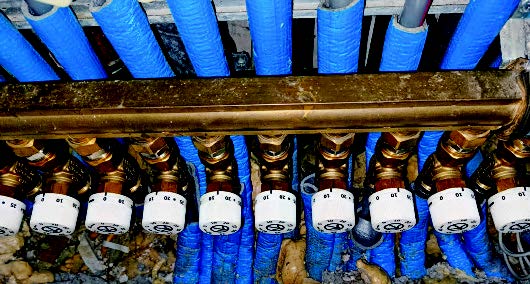
However, consultant Westermann was not satisfied with this 6.06 for his sister’s four-family house. At an event organised by HG Baunach GmbH & Co. KG, he had heard about their development, the “RTB” control valves. These replace the usual radiator thermostats and are screwed into the return pipe of a heating circuit. The thermostatic valves for individual room control on each radiator are no longer necessary. The advantage: the “RTB” regulates the flow volume; it does not shut off individual radiators. They measure water temperatures, not air temperatures like the common “click-clack” valves, as Westermann puts it. “There, the air temperature is always hammering, and the radiator is always cold. They measure water temperatures, not air temperatures, unlike the common “click-clack” valves, as Westermann puts it. There, the constantly circulating water at a constant temperature hammers against closed shut-off devices in the heating circuit when there are sudden solar gains, with the result that the heat pump switches off and cycles. This on/off cycling is at the expense of the COP and puts particular strain on the compressor, whose service life depends on the number of cycles. It is better to regulate the flow volume with RTB valves. the heat pump switches off and cycles. This on/off cycling reduces the COP and puts particular strain on the compressor, whose service life depends on the number of cycles. It is better to reduce the volume and let the heat pump run for as long as possible.” “With the ‘RTB’, you set the return temperature on the dial that corresponds to your desired room temperature. When sunlight enters the room, the temperature rises. The RTB then automatically increases the return temperature to prevent the heat pump from cycling.” “With the “RTB”, set the return temperature that corresponds to your desired room temperature on the scale on the rotary knob. If sunlight enters the room, the return temperature rises. The “RTB” closes by an amount or throttles to a flow rate until the preselected return temperature and thus the desired room temperature is reached again. The “RTB” closes by a certain amount or throttles to a flow rate until the preselected return temperature and thus the desired room temperature is reached again. The heat pump remains in operation. All circuits of an underfloor heating system are flowed through. A minimum circulation of about 30 per cent is ensured,” explains the planner. All circuits of an underfloor heating system are flowed through. A minimum circulation of around 30 per cent is ensured,” explains the planner.
Proactive control
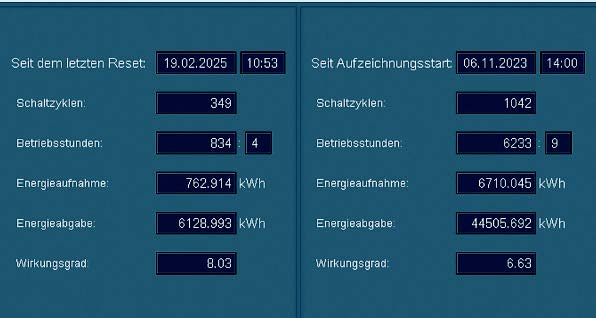
According to his records, the heat generator runs for up to 14 hours in individual cases. He had converted to the “RTB” in February 2025. The SCOP had climbed from 6.0 to over 7.0 in four months. “Although the 7.0 still includes some of the earlier thermostatic valves. I think if I subtract those, we’re approaching 8.0.” Westermann attributes the initial 7.0 to the warm winter, the quality of the heat pump, the absence of a buffer tank, the control system that queries the weather for the next day and takes it into account, and a hot water stratified storage tank with low losses. The heat pump installed here comes from Lambda in Tyrol. According to Lambda Wärmepumpen GmbH, one of its distinguishing features is optimised heat transfer from the energy source (air, water, geothermal energy) to the refrigerant. The evaporation temperature of the refrigerant (propane, R 290) is supposed to be very close to the energy source temperature due to a patented flow mechanism, which significantly increases heat extraction. is supposed to be very close to the energy source temperature due to a patented flow mechanism, so that the heat extraction is significantly increased. According to the manufacturer’s product description, further measures have also been taken to increase efficiency.
The potential for improvement
The point “heat exchanger” is also mentioned by Dr.-Ing. Marek Miara from Fraunhofer ISE, the recognised leading scientist in Germany for heat pumps in old buildings, in his response to a query from the author. The author had asked about the size and possibilities for improving the loss coefficient in the “Carnot formula”. Only the screw can be turned, not the temperatures, such as the local outside temperature. Unless, of course, the air/water heat pump is installed in a building with a very low temperature. Only the screw can be turned, not the temperatures, such as the local outside temperature. Unless the air/water heat pump fills a buffer tank at the daily maximum temperatures – lower delta T – instead of at the low temperatures at night. However, electricity is cheapest at night. The room temperature or flow temperature, the second parameter in the Carnot formula, depends primarily on the heat load of the building. However, electricity costs the least at night. The room temperature or flow temperature, the second parameter in the “Carnot formula”, depends primarily on the heat transfer – underfloor or radiator heating – and is specific to the property; it is therefore also almost a constant, apart from a 1 or 2 K higher or lower desired temperature. The “loss coefficient” coefficient, on the other hand, is determined by the heat pump manufacturers and heating engineers. “The machine can be improved,” writes Marek Miara, “if I either improve individual components (compressors with fewer losses, heat exchangers, better expansion valves) or optimise the refrigeration circuit (better distribution of the fluid, less overheating and/or undercooling, intermediate circuits, additional internal heat exchangers) and achieve better control of the refrigeration circuit. And ultimately, a better connection to the heating system. Of course, it is best if all these elements are optimised at once.”
The weaknesses of retroactive calculation
Incidentally, the Carnot efficiency factor is rarely used by non-specialists. Even manufacturers hardly ever use it. The explanation is obvious: its magnitude is based on the temperatures at the place of use on the one hand, and on the installation diagram. Neither of these areas is the responsibility of the industry. In retrospect, it is also difficult, despite the simple formula, to calculate the integrated loss coefficient from the monitoring because “it is not that easy to get the correct temperatures.” In other words, monitoring over a period of several months accurately reflects the JAZ for this period to one or two decimal places, but it is impossible to clearly determine whether, for example, the temperatures or the coefficient according to the “Carnot formula” were decisive for the JAZ of 2.8. The Fraunhofer ISE has recalculated the JAZ of more than 100 existing heat pumps Fraunhofer ISE has recalculated the JAZ of more than 100 existing heat pumps. A further breakdown of this overall efficiency by temperature and technology is not possible at this stage because the necessary temperature data is missing or would be very difficult to obtain. Nevertheless, the study authors ventured an estimate: “We did not see 0.5 as a Carnot coefficient, but rather 0.3 to 0.45. However, the technology has now matured to the point where we can expect a value closer to 0.5.” The study authors also noted that the JAZ is not a reliable indicator of the actual efficiency of heat pumps. This is because the JAZ is based on the theoretical maximum efficiency of a heat pump, which is not achieved in practice. Nevertheless, the study authors ventured an estimate: “We did not see 0.5 as a coefficient according to Carnot, but rather 0.3 to 0.45. However, the technology has improved in the meantime. But achieving more than 0.6 even in the future is likely to be very ambitious,” says Miara, doubting a leap in technical development. Among other things, he cited the difficulties for the industry in listing the components with potential for improvement.
The house as a heat storage unit
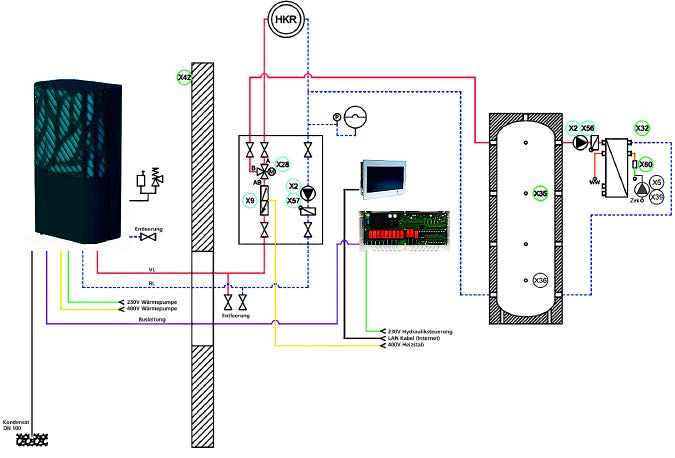
The manufacturer’s partner, the plant engineer, on the other hand, still has room for improvement in terms of its influence on the coefficient and thus on the total Carnot efficiency of an air-water heat pump system. “And ultimately, a better connection to the heating system,” as Marek Miara put it. The “RTB” is an important step in this direction. In addition, Bischweier has dispensed with a heating water buffer. The entire house, with its mass of 100 tonnes and more, acts as a storage tank. “In general,” says Westermann, “In general,” says Westermann, “you charge a buffer at the cheapest tariff times, when electricity is cheapest. But you can also use the house for this. If you use the control system to overheat it by 1.5 K for two hours at the lowest tariff, for example, the heat will last will last the whole day. You avoid the losses that occur when storing the heat in a buffer with an additional mixer. You have to heat the water tank to at least 40 °C and then mix the contents down to 28 °C for the underfloor heating. This is at the expense of the COP. You have to simplify the hydraulics, modulating directly This is at the expense of the COP. You have to simplify the hydraulics, modulating directly from the heat pump to the heating circuits.”
No heating bill
A high coefficient of performance not only flows into the electricity bill, but also has a completely different impact on the annual balance sheet. The heating cost bill for tenants can be omitted in buildings with a heat requirement of less than 15 kWh/m2a. This is permitted under Section 11 of the Heating Costs Ordinance. The 400 m2 of the Bischweier house consumed around 1,000 after the new heating circuit control system was installed, with 2.5 kWh/m². A harsh winter may double or triple this minimum value, but the landlord is still spared the bureaucratic task of distributing heating costs. Real operating data from the four-family house: on the right – Carnot efficiency (JAZ) without “RTB” control valves, on the left – Carnot efficiency after “RTB” control valves.

-
Administration
- Übersicht
- Fachpartnersuche
-
Benachrichtigungen
-
Termine
-
Content-Bereich
-
Support
-
Analytics